ETG · General Paper June Holiday Intensive · 22–24 June 2026 Coronation Plaza · Zoom
A LEVEL GP · SINGAPORE · JUNE 2026

Three days. Three components. Built for what June actually demands.

A crashcourse on the year's most consequential essay topics — Trump 2.0, Singapore's arts hub debate, biodiversity and geoengineering. Six comprehensions. Eight essays. All marked. One exclusive textbook to keep. 22–24 June 2026 at Coronation Plaza and Zoom.

3
Days · One Bundle 22 — 24 June 2026
01 — The Problem

June is when the second half of JC takes shape.

For JC1 students, promos are eight to twelve weeks away. For JC2, prelims are around the corner. The school holidays are the one block of unbroken time before the term re-starts at full pace — and the strongest students treat them as the inflection point, not the rest period.

i.

The JC term has competing demands.

GP shares the timetable with five or six other subjects, each running at full pace. By June, most students will have written five to eight essays — which is what the term realistically allows. The volume gap isn't anyone's fault; it's structural. The holidays are where it can be closed without anything else getting squeezed.

ii.

The contemporary content moves in real time.

Trump's second term. Singapore's SG Culture Pass. The Cross Island Line tunnel. The 2025 IEEPA ruling. The most exam-relevant material for the 2026 and 2027 cohorts is being written this year. It takes a structured block of time — and a structured chapter — to absorb it properly.

iii.

Comprehension and essay technique improve with reps.

Reading widely is essential — but it doesn't move marks on its own. Writing under timed conditions, marked, and revisited — that's where the band shifts. Two of the three days here are exactly that: six comprehensions and eight essays, all assigned, all marked.

"I read the news, I think I know what's happening — but I can't write a decent essay on it."

— What most students realise in June
02 — The Reframe

What three days can and cannot do.

Three days are not a substitute for a full programme. They will not replace the long-game work that the strongest GP results come from. What they can do — when designed properly — is compress the highest-leverage practice and content into the only block of unbroken time most JC students get in a year.

The intensive is built around three components: contemporary content delivered with structure, so it's organised, not fragmented; comprehension volume under marking, so AQ technique gets the deliberate practice it deserves; and essay reps with feedback, so writing under time pressure becomes practice, not discovery.

Each day is a different leverage point. None of them, alone, is the programme. Together, in three consecutive days, they compress what a school term cannot easily concentrate.

03 — Three Days, Three Components

The architecture of the intensive.

Each day is a discrete, complete component — but the three are designed to compound. Day 1 is the content base. Days 2 and 3 are the application of it under marking conditions.

01. Mon · 22 June · 10am – 3:30pm

GP Essentials Crashcourse 2.

Three contemporary chapters delivered in 4.5 hours of teaching. Environment (biodiversity and geoengineering), Singapore arts and the SG Culture Pass debate, and Mr President — a deep, non-partisan analysis of Trump 2.0 and what it means for Singapore. The three chapters are mapped to recent past-year questions and to where the 2026 and 2027 papers are likely to go.

02. Tue · 23 June · 10am – 3pm

Comprehension Bootcamp.

Six full comprehension passages, assigned as homework before the day. Worked through methodically: passage navigation, explanation and inference questions, summary technique, and the AQ. Time management is taught explicitly, not implied. Every comprehension is marked and returned with feedback.

03. Wed · 24 June · 10am – 3pm

Essay Bootcamp.

Eight essay questions, assigned as homework before the day. Worked through with focus on argument architecture, paragraph evaluation, and how to use Singapore as the analytical lens — not the afterthought example. Each essay is marked, returned, and discussed against the band descriptors. Most students will write more in this single day than in a full term of school.

Three days, structured. Not three days, ad hoc.

Pre-work is assigned. Days run with full marking and feedback. The bundle includes the exclusive textbook.

04 — By the Numbers

What you walk away with, in figures.

Every figure here is concrete and bundled. Nothing is aspirational.

3 Days

22, 23, 24 June 2026 — Mon, Tue, Wed.

14 Pieces Marked

Six comprehensions and eight essays — all returned with feedback.

3 Crashcourse Chapters

Environment, Arts in Singapore, Mr President.

$400 Bundle Price

Standalone total $500. The bundle saves $100 and is the only way to access the textbook.

05 — The Crashcourse Topics

Three chapters. Built for 2026.

Each chapter is the kind of treatment you wouldn't expect at a holiday intensive. Sharp, contemporary, Singapore-anchored, and mapped explicitly to recent past-year questions. The three previews below are drawn from the actual chapter material.

01.

The Environment — Biodiversity and Geoengineering.

Mon 22 June · 10am – 11:30am

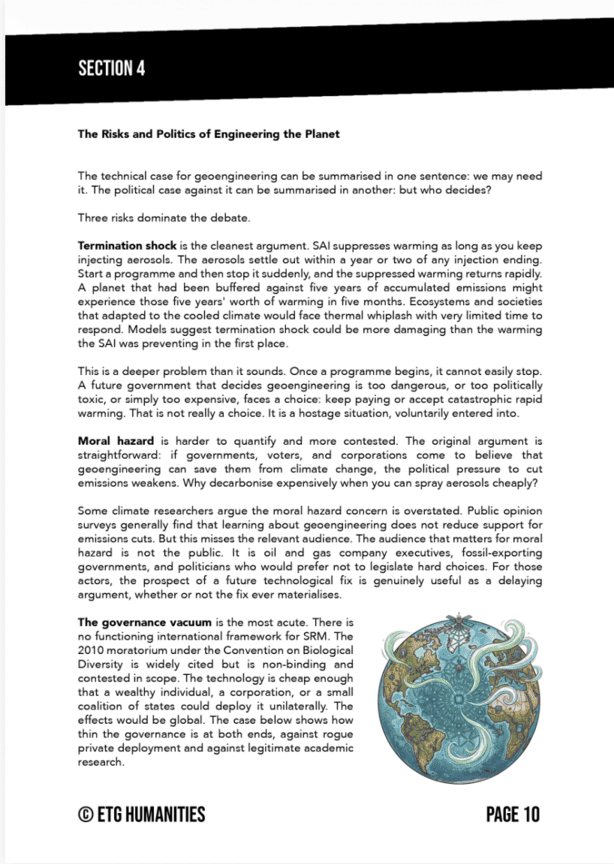
Biodiversity loss and geoengineering look unrelated. They ask the same question: how much should humans remake nature, on whose authority, and who pays the cost? From Singapore's 2024 mass coral bleaching event, through the Cross Island Line's 70-metre tunnel, to Solar Radiation Management and the governance vacuum exposed by Make Sunsets — the chapter treats the environment as a question of distributive justice, not just policy.

Cases & figures covered
  • WWF Living Planet Report — the 73% figure, used correctly
  • The Cross Island Line and the 70-metre tunnel
  • Make Sunsets vs SCoPEx — the governance vacuum
  • Singapore carbon tax progression
  • Climeworks Mammoth — design vs reality
Past-year questions it equips you for
  • 2025 Q3 — too much concern about the environment
  • 2024 Q3 — environment vs economic development
  • 2020 Q3 — climate change and economic sacrifice
  • 2018 Q2 — attempts to control climate change futile
02.

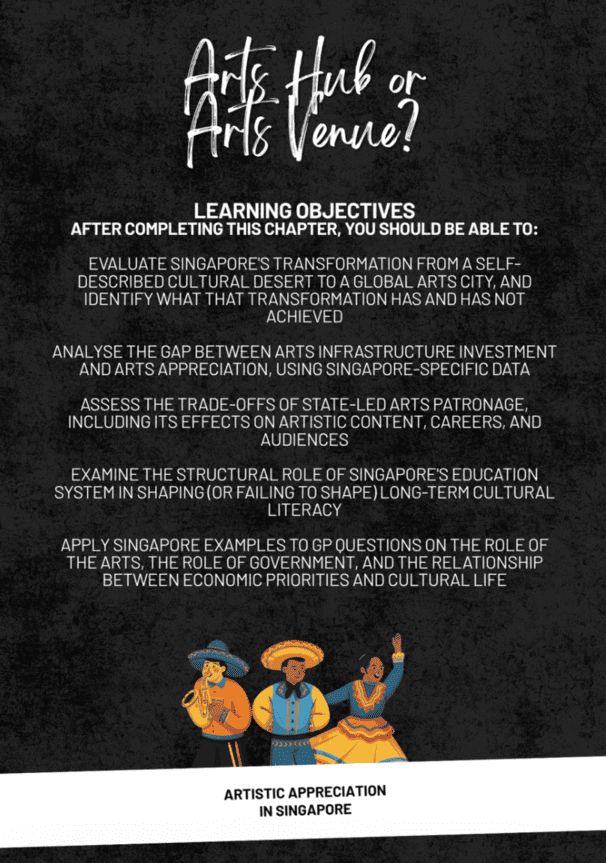
Arts & Culture — Artistic Appreciation in Singapore.

Mon 22 June · 12pm – 1:30pm

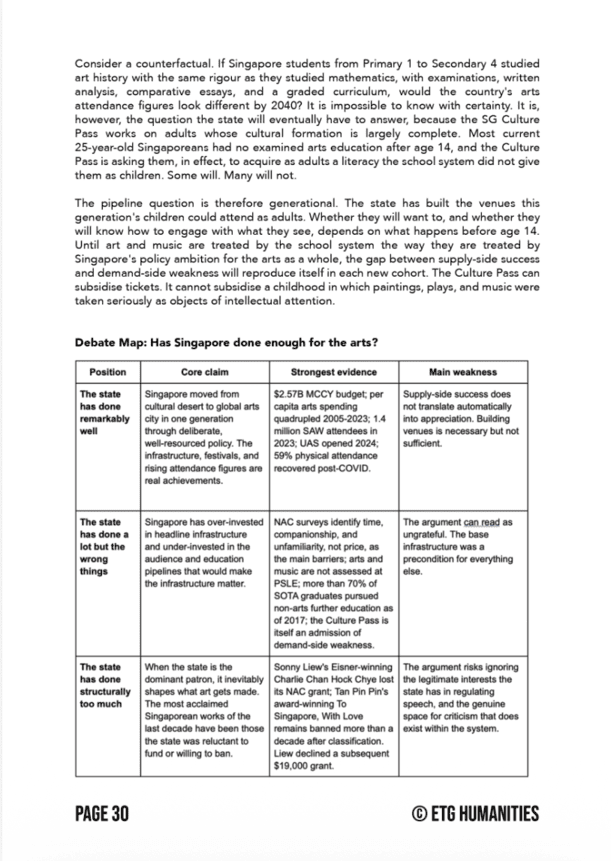
Has Singapore built an arts hub, or just a collection of arts venues? The chapter uses the SG Culture Pass — launched September 2025 — as a window onto a deeper question. From the 1989 ACCA Report through three Renaissance City Plans to the National Gallery and the University of the Arts, the infrastructure is real. The audience, the careers, and the school pipeline are where the gap is.

Cases & figures covered
  • SG Culture Pass — what it admits about supply and appreciation
  • Sonny Liew — the withdrawn $8,000 NAC grant and the Eisner Awards
  • Tan Pin Pin — To Singapore, With Love still banned
  • SOTA — and the 70% non-arts graduate question
  • Arts graduate vs law/IT salary asymmetry
Past-year questions it equips you for
  • 2025 Q7 — arts for economic vs own sake
  • 2023 Q8 — to what extent the arts can change society
  • 2021 Q5 — sciences and arts equally important
  • 2020 Q2 — local vs foreign talent in the arts
03.

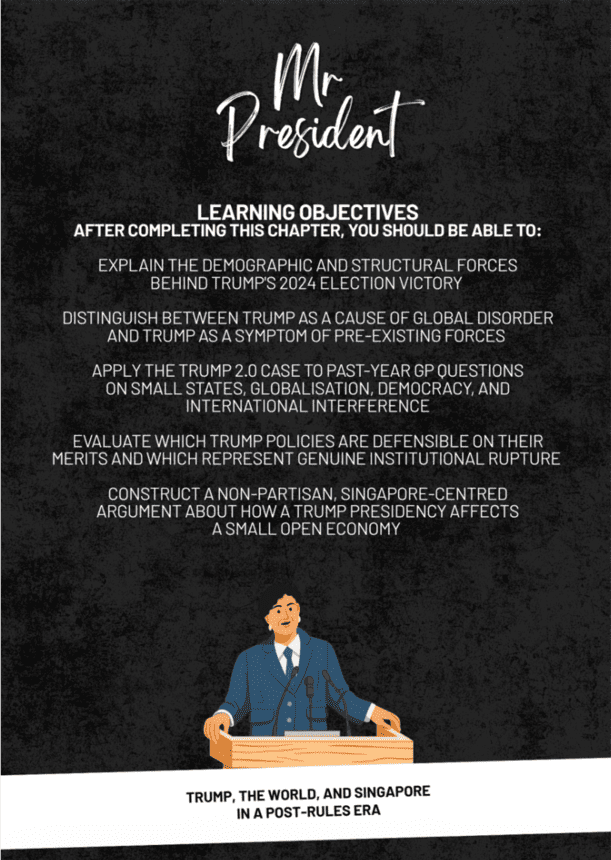
Mr President — Trump, the World, and Singapore.

Mon 22 June · 2pm – 3:30pm

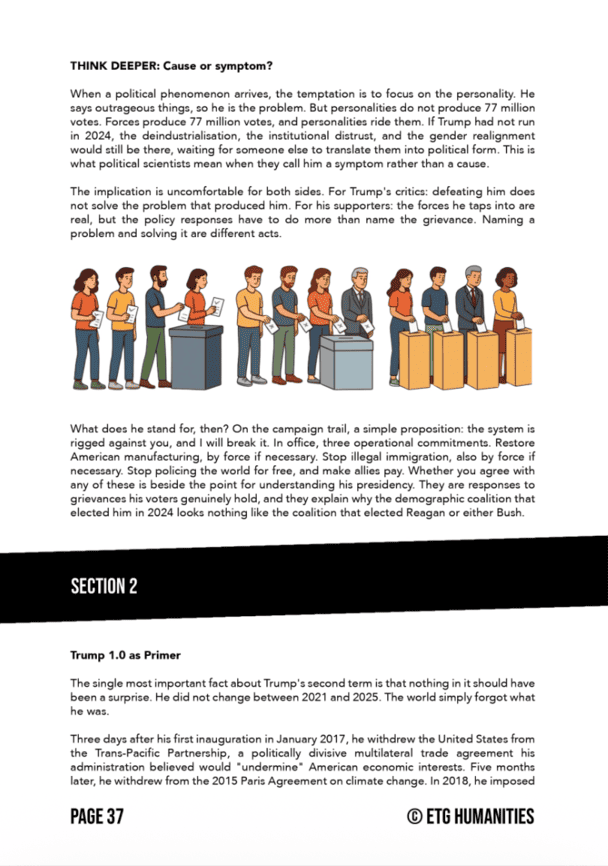
Is Trump the cause of global disorder, or its symptom? The honest answer is both, in different ways — and learning to hold that tension without collapsing into a partisan reflex is the chapter's core skill. From the 2024 demographic realignment, through Liberation Day tariffs and the Supreme Court's IEEPA ruling, to two wars with Iran and Singapore's refuse to choose doctrine under pressure — the chapter treats the most consequential political phenomenon of the cohort's lifetime as something to think clearly about, not to take a side on.

Cases & figures covered
  • The 2024 demographic realignment — the structural read
  • Liberation Day tariffs and the Supreme Court's IEEPA ruling
  • Section 122 pivot — the workaround
  • Two wars with Iran (2025 and 2026)
  • Singapore's "refuse to choose" doctrine — and where it breaks
Past-year questions it equips you for
  • 2025 Q9 — small countries and globalisation
  • 2024 Q10 — interference in the affairs of another country
  • 2023 Q9 — small countries and influence
  • 2022 Q8 — democracy as the worst form, except all the others
  • 2025 Q1 — technological progress and danger
06 — The Bootcamps

Volume, marked. Two days, fourteen pieces.

The two bootcamp days deliver fourteen pieces of writing — six comprehensions and eight essays — every one of them attempted and marked. The pre-work is the point. Students arrive having already done the writing; the day itself is for working through it, learning from it, and locking in technique.

02. Day 2 · Tue 23 June

Comprehension Bootcamp.

Six full comprehension passages, all assigned as homework before the day. Worked through methodically: passage navigation, explanation and inference questions, summary technique, vocabulary in context, and the AQ. Time management is taught explicitly, not implied. Every comprehension is marked and returned. AQ — the twelve marks most students underprepare — gets dedicated treatment.

6 comprehensions · 1 day · all marked 10am – 3pm · Coronation Plaza & Zoom
03. Day 3 · Wed 24 June

Essay Bootcamp.

Eight essay questions, assigned as homework before the day. The day works through argument architecture, paragraph evaluation, and how Singapore is used as the analytical lens — not the afterthought example. Each essay is marked, returned, and discussed against the band descriptors. By the end of Wednesday, every student walks away with a concentrated block of marked essay output and a clearer sense of where their writing currently sits.

8 essays · 1 day · all marked 10am – 3pm · Coronation Plaza & Zoom

The eight essay themes, previewed.

Six of the eight essays extend directly from the three crashcourse chapters; two are cross-cutting prompts that reward strong students who can integrate themes. The exact wording is held back until the day — but the territory is set, and so is the forecast logic behind each choice.

01

Climate change and technology.

The full SRM and CDR ladder, the governance vacuum, and the climate-justice frame — who deploys, who pays. The "more harm than good" framing recurs almost every cycle; a climate-and-tech variant is overdue.

Extends · The Environment
02

Biodiversity as a luxury good.

The Cross Island Line tunnel as the centrepiece evidence, contrasted against tropical countries that cannot tunnel under their forests. Sits at the intersection of conservation and economic development.

Extends · The Environment
03

The rules-based international order.

PM Wong's "rules-based globalisation is over" framing maps directly onto this. IEEPA tariffs, NATO free-riding pressure, the Iran wars, Greenland and Panama — students steelman the view that the order was always selective.

Extends · Mr President
04

Democracy in today's world.

Extends 2022 Q8 directly into Trump 2.0 territory. The cause-vs-symptom framework is the gift here: institutional erosion that is itself democratic in origin — the kind of nuance Cambridge rewards at Band 1.

Extends · Mr President
05

Schools and the appreciation of the arts.

The education pipeline problem. The SOTA paradox — the high share of graduates leaving the arts. The signal asymmetry of non-examined subjects. A cross-cutting prompt joining the recurring education thread to the arts thread.

Extends · Arts & Culture
06

Government support for the arts.

Renaissance City Plans, the Esplanade, NAC, NHB, UAS, the SG Culture Pass. The strongest scripts use the supply-vs-appreciation gap to argue the question is not how much support, but what kind.

Extends · Arts & Culture
07

Capital punishment in modern society.

Singapore as one of the few developed states still executing for drug offences. The broader punishment theme that has appeared repeatedly in recent papers, with unusually rich Singapore-specific evidence currently available.

Cross-cutting · Society & Ethics
08

Falling birth rates and demographic challenge.

Singapore's TFR at 0.97 and the public warnings of population contraction by the early 2040s. A cross-cutting prompt intersecting economy, gender, immigration, and housing — the kind that rewards the strongest students.

Cross-cutting · Society & Economy
1
Exclusive Intensive Textbook

The textbook only the bundle gets.

An in-house textbook produced specifically for this intensive — three full chapters on the crashcourse topics, six comprehension passages with marking schemes, and eight essay questions with structured guides. Same production standard as the regular ETG GP textbooks (each costs $49.90 to produce). Yours to keep. Available only via the bundle.

Three days. One bundle. $400 — saves $100.

The textbook is included. Pre-work is assigned. JC1 and JC2 students welcome.

07 — The Schedule

When and where.

All three days run at Coronation Plaza, with a parallel Zoom option for students unable to attend in person. The intensive runs across three consecutive weekdays in the first week of the June school holidays.

Day
Component
Date · Time
Location
01.
Essentials Crashcourse Environment · Arts · Mr President
Mon 22 Jun
10am – 3:30pm
Coronation Plaza
+ Zoom
02.
Comprehension Bootcamp 6 comprehensions, all marked
Tue 23 Jun
10am – 3pm
Coronation Plaza
+ Zoom
03.
Essay Bootcamp 8 essays, all marked
Wed 24 Jun
10am – 3pm
Coronation Plaza
+ Zoom

Crashcourse runs with two short breaks between the 1.5-hour topics. Pre-work for the Comprehension and Essay bootcamps is assigned upon registration.

08 — Pricing

The bundle is the way in.

Components can be taken individually, but the textbook and the price advantage are bundle-only.

Component
Standalone
In Bundle
GP Essentials Crashcourse 2 Mon 22 June · 3 topics · 4.5 hours
$100
included
Comprehension Bootcamp Tue 23 June · 6 comprehensions, marked
$200
included
Essay Bootcamp Wed 24 June · 8 essays, marked
$200
included
June Holiday Intensive Pack All three days · exclusive textbook · saves $100
$500
$400
Bundle-only Inclusions

The exclusive intensive textbook is bundled with the full pack only. Standalone bookings receive their session materials but not the bound textbook.

Existing ETG GP Students

Open to current students and to non-students alike. No prior enrolment required. Multi-subject and group registration discounts from the regular programme do not stack with the intensive bundle pricing.

09 — Common Questions

Common questions, answered honestly.

If your question isn't here, message the admin team on WhatsApp — replies are usually within the day.

Both. The crashcourse content is built around topics that are exam-relevant for both 2026 and 2027 cohorts. The bootcamps are structured for any JC student writing GP, with the marking and feedback adjusted to where the student is. JC1 students typically use it as the inflection before promos; JC2 students use it as a structured volume push before prelims.

Yes. The intensive is open to non-ETG students and existing ETG students alike. No prior enrolment is required. For students joining ETG for the first time through the intensive, the textbook and the experience of the bootcamps are designed to be fully self-contained.

Each component can be booked standalone — the Crashcourse at $100, each bootcamp at $200. The bundle at $400 is the only way to get all three days plus the exclusive textbook, and it saves $100 versus standalone pricing. If you can only attend two days, message the admin team — pricing for partial bundles is handled case by case.

The Comprehension Bootcamp asks for six comprehensions to be attempted before the day. The Essay Bootcamp asks for eight essays to be attempted before the day. Both are spread across the days leading up to the intensive — students who register earlier have more time. The pre-work is not optional; the bootcamp days are built around what students bring in. This is the design.

Yes. The three crashcourse chapters are written to be referenced for the rest of JC. The Mr President chapter alone is around 3,500 words of analysis with sourced statistics; the Environment and Arts chapters are similarly substantial. The marked comprehensions and essays are reference material students continue to revisit through prelims and A Levels.

Yes. All three days are available both at Coronation Plaza and on Zoom in parallel. Pre-work and marking are handled identically across both modes. The textbook is mailed to Zoom students before the intensive begins.

No single intensive changes a grade. GP does not improve after one workshop. What three days can do is install structure — argument architecture, AQ technique, time discipline — and produce a concentrated block of marked output. Whether that translates to a grade movement depends on what happens after the intensive. The strongest outcomes come from students who treat the intensive as the start of a more structured second half of JC.

Two things. First, the content currency: the crashcourse chapters are written for the 2026 and 2027 papers, not recycled from prior years. Trump's second term, the SG Culture Pass, the Cross Island Line — these are anchored in 2025–2026 developments, not 2020 examples. Second, the marking volume: fourteen marked pieces across two days is a concentrated block of feedback that's difficult to replicate elsewhere — and the marking is done by ETG GP tutors, with detailed feedback per piece and reference to the band descriptors.

Registration is via the Typeform link at the top of this page or via the Register Now button in the pricing section. Once submitted, the admin team will confirm your slot and send pre-work instructions. For any registration issues, message the admin team on WhatsApp.

June 22, 23, 24. Decide what they count for.

Three days, three components, one bundle. The textbook is included. Pre-work is assigned. The strongest students of any JC cohort treat the school holidays as the leverage window. The intensive is built for that decision.

Everything. Covered.
ETG General Paper · Singapore
Register Now 💬 WhatsApp